The Torpedo That Came Home: How the USS Tullibee Was Destroyed by Its Own Weapon
Photo: Unknown authorUnknown author, Public domain, via Wikimedia Commons
War produces a specific kind of terrible irony — the kind where the very thing designed to protect you becomes the thing that kills you. Friendly fire, equipment failure, the brutal randomness of combat: history is full of soldiers and sailors brought down by forces that weren't supposed to be pointed in their direction.
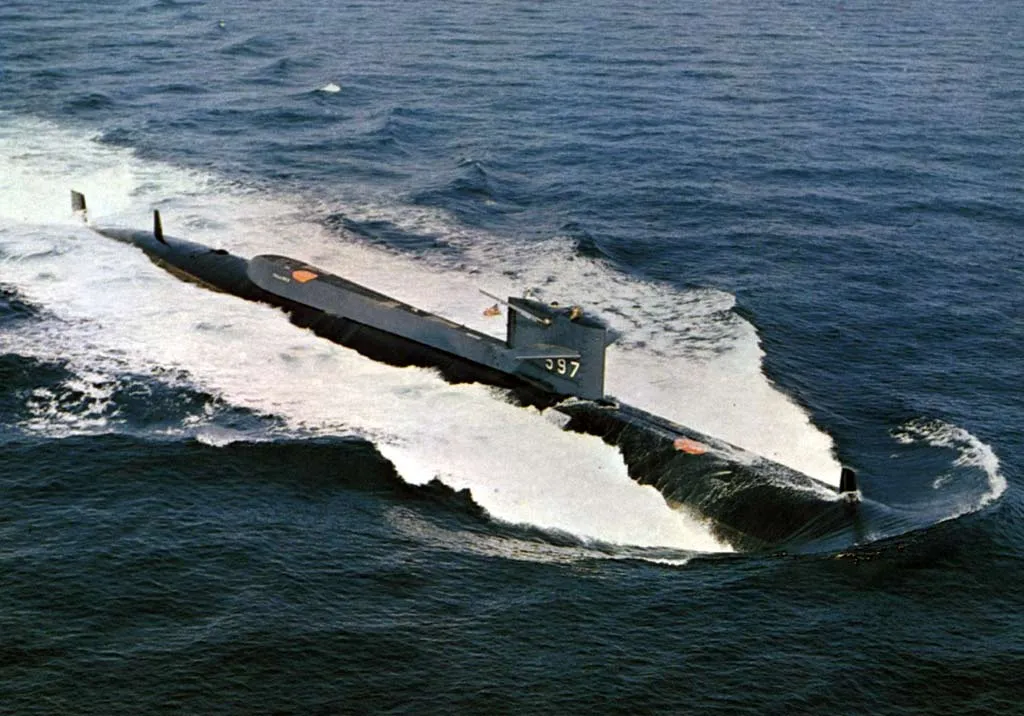 Photo: USS Tullibee, via i0.wp.com
But even by those grim standards, what happened to the USS Tullibee in the early hours of March 26, 1944, stands in a category almost entirely its own.
A Submarine on the Hunt
The Tullibee was a Balao-class submarine — one of the workhorses of the U.S. Navy's Pacific campaign. By the spring of 1944, American submarines had become a critical strategic weapon, strangling Japanese supply lines and hunting enemy convoys across thousands of miles of open ocean. The Tullibee had already completed two war patrols and was on its third when it encountered a Japanese convoy northwest of Palau.
The conditions were rough. Night attacks on surface convoys were standard practice for U.S. submarines, and the crew was experienced. Commander Charles Brindupke ordered a torpedo spread and the Tullibee fired.
What happened next took less than a minute to end 79 lives.
The Physics of a Circular Run
Torpedoes are not simple weapons. They are essentially self-guided underwater projectiles, and like anything that relies on mechanical guidance systems under extreme pressure and at high speed, they can malfunction. One of the most feared malfunctions was something submariners called a "circular run" — when a torpedo's gyroscope or steering mechanism failed mid-flight and the weapon began curving back toward the vessel that fired it.
The danger was well understood. The probability was considered low. But the Pacific Ocean is unforgiving of low probabilities when they finally materialize.
The Tullibee's torpedo curved. It completed a wide arc through the dark water and struck the submarine from behind, detonating against the hull with catastrophic force. The explosion was immediate and devastating. The Tullibee sank in minutes.
One Man Left
Of the 80 men aboard, only one survived: Gunner's Mate C.W. Kuykendall.
 Photo: C.W. Kuykendall, via cdn.chime.me
Kuykendall was on the bridge when the explosion hit. The blast threw him into the water. Dazed and badly disoriented, he managed to stay afloat through the night, clinging to whatever debris he could reach in the darkness. He could hear other survivors in the water around him — voices calling out in the chaos — but by dawn, those voices had gone quiet. One by one, the other men slipped beneath the surface.
Kuykendall was alone in the open Pacific.
He was eventually picked up — not by a U.S. rescue vessel, but by a Japanese destroyer. He spent the rest of the war as a prisoner of war in Japan, surviving captivity only to face the task of explaining, once the war ended, what had happened to his ship and his crewmates.
His account was the only firsthand testimony the Navy had. There were no other witnesses. No other survivors. Just one man's memory of a night that shouldn't have ended the way it did.
The Navy's Uncomfortable Reckoning
For the Navy, the Tullibee's loss raised questions that had no comfortable answers. Circular runs weren't unheard of — there had been other incidents, other near-misses — but the complete destruction of a submarine and nearly its entire crew was a different order of problem entirely.
The Mark 14 torpedo, the standard weapon used by U.S. submarines for much of the war, had already been the subject of significant controversy. Early in the Pacific campaign, submariners had complained bitterly that the Mark 14 ran too deep, failed to detonate on contact, and behaved unpredictably under combat conditions. The Navy's Bureau of Ordnance had been slow to acknowledge the problems, insisting the weapon performed as designed even as crews returned from patrols reporting torpedo after torpedo had failed to hit or explode.
The circular run issue was a separate but related failure mode — one that the Tullibee's loss made impossible to quietly dismiss. When your own weapon destroys your own vessel, the weapons program needs a hard look.
Improvements to gyroscopic controls and guidance systems were accelerated in the years that followed, driven in part by incidents like the one that took the Tullibee down. The Navy doesn't advertise those lessons loudly, but they're embedded in the engineering history of every torpedo that came after.
The Names That Almost Got Lost
For decades, the story of the Tullibee occupied a strange space in naval history — known among submarine historians, but not widely recognized outside that community. The circumstances of its sinking were unusual enough that early records were incomplete, pieced together from Kuykendall's postwar debriefing and whatever physical evidence the Navy could reconstruct.
There's a particular kind of tragedy in dying at the hands of your own equipment, fighting for your country in a war where the weapons were supposed to be on your side. The 79 men who went down with the Tullibee didn't die in a conventional sense of combat. They died because a piece of machinery made a single, catastrophic error in the dark.
The submarine was posthumously awarded battle stars. Kuykendall received recognition for his survival and his testimony. And somewhere in the dry technical language of Navy ordnance reports, the Tullibee's loss is recorded as a data point — a circular run, a hull impact, a total loss.
For the men on board, it was something else entirely.