Signal From Nowhere: The Mountain Bunker That Kept Broadcasting After Everyone Forgot It Existed
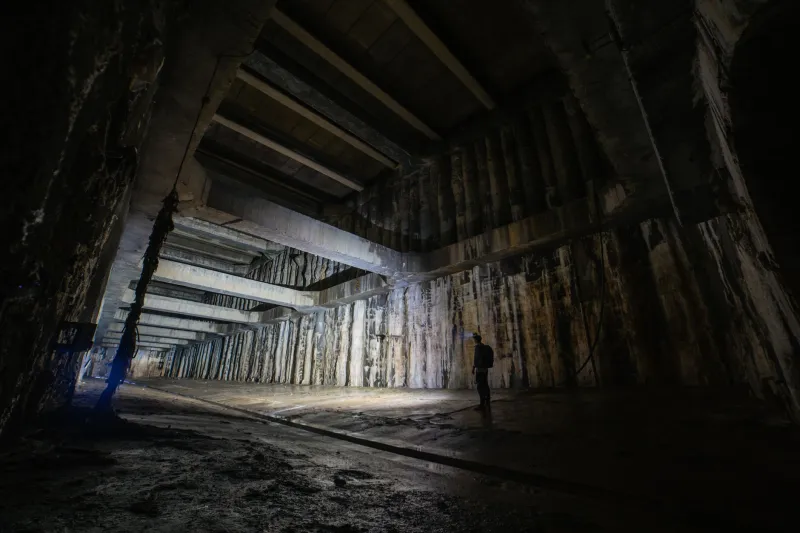
Imagine flipping on the radio during a long desert drive, finding a clear station cutting through the static, and assuming — reasonably — that it's beaming down from some mundane tower on a hill somewhere. Now imagine that station has been transmitting from inside a mountain for forty years, staffed by a skeleton crew that never quite got the memo that their employer had restructured, relocated, and more or less moved on without them.
That's not a premise from a Cold War thriller. It's what happened at one of the stranger corners of American broadcast history.
Built to Survive Everything
The facility's origins made a certain kind of paranoid sense. During the early years of the Cold War, the Federal Communications Commission and the Department of Defense quietly encouraged — and in some cases funded — the construction of hardened broadcast infrastructure. The idea was simple: if nuclear war came, you'd still want the airwaves running. Emergency broadcasts needed to reach people even if every above-ground tower in a region had been vaporized.
Several of these facilities were carved directly into mountainsides or buried under thick rock formations across the mountain West and the Pacific Northwest. They were designed with reinforced walls, independent power generation, and enough supply storage to keep a small crew operational for months. From the outside, most of them looked like nothing at all — a ventilation grate, maybe a locked service door set into a rock face, and a lot of empty terrain around it.
The one at the center of this story was commissioned by a regional broadcasting group in the late 1940s and completed sometime around 1951. It sat inside a natural granite formation at roughly 7,000 feet elevation, accessible only by a narrow service road that became impassable in heavy snow. The crew that ran it — usually two or three people at a time — lived on-site for weeks at a stretch, rotating in and out on a schedule that the outside world mostly ignored.
The Part Where Things Got Weird
Here's where the story tips from unusual into genuinely hard to believe.
Over the following decades, the regional broadcasting company that owned the facility went through a series of mergers, acquisitions, and corporate restructurings — the kind of mid-century consolidation that swallowed up dozens of small American media operations and scrambled their paperwork in the process. During one of those transitions, the mountain facility's operational records were either misfiled or simply not transferred to the new parent company's administrative system.
The transmitter kept running. The crew kept rotating. The signal kept going out.
But at the corporate level, the facility had effectively ceased to exist on paper. It wasn't generating direct revenue in any trackable way — its signal was being picked up and rebroadcast by a relay network that operated semi-autonomously, and the billing for the facility's utility connections had been quietly absorbed into a broader regional account that nobody scrutinized closely. For years, then decades, the mountain station just kept doing what it had always done, invisible to the people who technically owned it.
The Audience That Never Knew
What makes this story genuinely strange — rather than just a bureaucratic comedy — is the audience on the other end.
The communities receiving the signal were spread across a wide, thinly populated stretch of high-altitude terrain. For many residents, the mountain station was simply the radio station. It was what came in clearly. It aired a mix of news, music, and local announcements that fit the rhythms of rural life in the region, and listeners had no particular reason to wonder about its origins. Radio towers were invisible infrastructure. You didn't think about them any more than you thought about the pipes carrying your water.
Some longtime residents apparently had a vague awareness that the station was "up in the mountains somewhere," but that was as far as the curiosity went. The signal was good. The programming was consistent. That was enough.
Rediscovered by Accident
The facility only came to light — in the corporate sense — when a newly hired infrastructure auditor at the parent broadcasting company decided to do something radical: actually reconcile the company's physical assets against its financial records.
What she found, buried in decades of accumulated account entries, was a utility line that didn't correspond to any facility in the company's active inventory. Following that thread eventually led her to a property deed, then to a service road, then to a locked door set into a granite face at the end of that road, and finally to a small crew of technicians who were, by all accounts, surprised but not particularly alarmed to receive a corporate visitor.
By various accounts, the crew had assumed that the unusual silence from headquarters was simply how the arrangement worked. They had a job. They did it. The checks — routed through a payroll system that had similarly slipped through the administrative cracks — kept arriving. Nobody had told them to stop.
Why It Still Matters
The story of the mountain station is easy to play for laughs — and it is, genuinely, a little funny. The image of a corporation losing track of an entire mountain facility because of bad filing is the kind of thing that belongs in a workplace comedy.
But it also says something real about the way large institutions handle inherited infrastructure, especially infrastructure built during an era of Cold War urgency and then quietly forgotten as the threat it was designed to address faded from the public imagination. Hardened broadcast facilities, underground relay stations, buried cable networks — the American communication landscape is riddled with infrastructure that predates the people now nominally responsible for it.
Some of it is carefully catalogued. Some of it, as one auditor discovered while working through a stack of unexplained utility charges, very much is not.
The mountain station was eventually decommissioned and its crew reassigned. The service road was gated. The signal that had been coming out of that granite hillside for four decades finally went quiet.
Listeners in the region noticed the silence. Most of them had no idea what they were mourning.