Smile, You're on Getaway Camera: The Roadside Billboard That Accidentally Photographed a Bank Robbery
Wrong Place, Right Moment
Here is the setup: a man on a road trip pulls over because he thinks a billboard is funny. He takes a photo. He drives on. He doesn't think about it again until federal investigators show up at his door.
This is a story about luck so specific and so absurd that it barely seems real. But it happened, and the photograph exists, and for a time in the late 1970s, it was the most important piece of evidence in a New Jersey bank robbery investigation.
The Billboard in Question
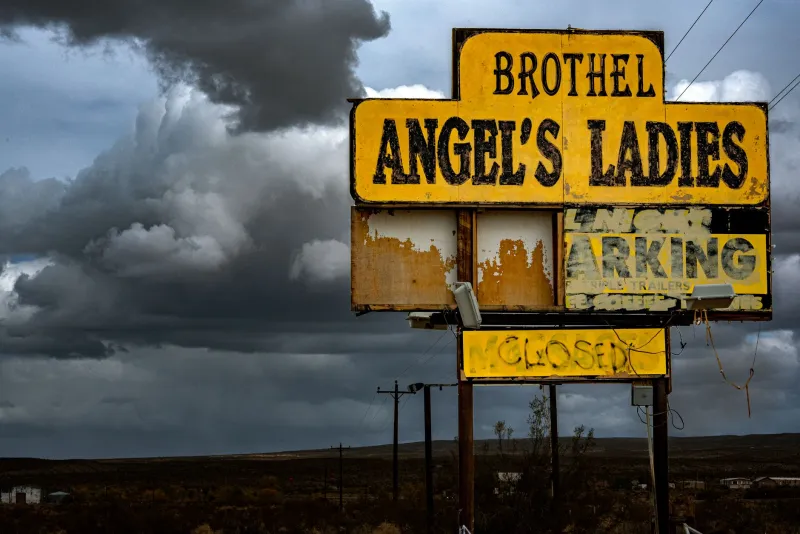
The sign was advertising a local business — accounts vary on whether it was a diner, a used car lot, or a hardware store, and the surviving documentation is vague on this point — but whatever it was selling, it had apparently made a memorable choice in its advertising copy. Quirky enough that a passing motorist found it worth stopping for.
The billboard had a glossy surface finish. This detail matters enormously, though nobody involved could have known it at the time. Glossy billboard surfaces were not universal in the 1970s — many signs used matte or painted finishes that absorbed light rather than reflecting it. This one was reflective enough to act, under the right conditions, almost like a mirror.
The motorist pulled over, stepped out of his car, and took a photograph of the sign. The date, confirmed later through the bank's own security timeline, was the same afternoon as the robbery. The location was within a half-mile of the bank.
He captured the sign clearly in the frame. He also, without knowing it, captured the street behind him — and a vehicle moving through that street at a speed inconsistent with normal traffic.
The Robbery Itself
The bank job was not particularly sophisticated. Three individuals entered a branch bank in northern New Jersey during business hours, presented weapons, collected cash, and left in a vehicle that witnesses described inconsistently. One witness said blue. Another said green. A third said she didn't get a look at the car at all.
The getaway route took the vehicle past the billboard.
Investigators at the time had almost nothing useful. The bank's own surveillance equipment — this was the 1970s, so expectations should be appropriately calibrated — produced images of limited quality. Witness accounts conflicted. No usable fingerprints were recovered from the counter. The case was active for several months before it began to stall.
How the Photo Surfaced
The motorist who took the photograph lived out of state. He developed his film after the trip, flipped through the prints, and filed them away in a shoebox. He had no reason to connect his roadside snapshot to anything newsworthy.
The connection came through an unlikely chain: a relative of the photographer mentioned the road trip in conversation with someone who worked in local law enforcement. The conversation was casual — something about a funny billboard on Route whatever — and it might have gone nowhere. But the officer, who happened to be tangentially involved in the robbery investigation, asked a follow-up question: when exactly was this trip?
The dates matched. The location matched. The officer asked if any photographs had been taken near the billboard.
The shoebox was located. The photograph was examined.
What the Image Showed
Under magnification, the reflection in the billboard's glossy surface revealed a vehicle. Not a crisp, clean image — this was a consumer camera, a reflective billboard, and a moving car, so clarity was always going to be limited. But enough was visible to establish the vehicle's approximate size, its color range (darker, possibly blue-green), and crucially, a partial view of what appeared to be a license plate.
The plate wasn't fully legible. But enough characters were recoverable to narrow the field dramatically. Combined with the color information and vehicle dimensions, investigators were able to identify a small pool of candidate vehicles registered in the region.
From there, traditional investigative work took over. The case, which had been cooling for the better part of a year, broke open within weeks of the photograph's discovery.
The Preservation Problem
What makes this story particularly strange is how close it came to never mattering at all. The motorist kept his photographs because he kept everything — he was, by his own description, a compulsive documenter of road trips. A different person discards the prints after a few months. A different conversation never happens. A different billboard has a matte finish and reflects nothing.
The case also predated the kind of forensic image enhancement that would have made the reflection analysis faster and more reliable. The work that extracted usable information from that photograph was painstaking and manual — analysts working with physical prints under magnification, comparing character shapes to known license plate fonts by hand. It took weeks. The technology to do it in hours didn't exist yet.
A Witness Made of Vinyl and Gloss
Law enforcement has always been opportunistic about evidence — you use what you find, not what you wish you had. But the New Jersey billboard case sits in a peculiar category because the evidence wasn't found at a crime scene. It was found in a shoebox in another state, in a photograph taken by someone who had no idea anything criminal was happening.
The billboard itself was eventually taken down, replaced by a different advertisement for a different business. The motorist's photograph, once it had served its legal purpose, presumably went back into storage somewhere.
But for a brief window in the late 1970s, a piece of commercial signage along a New Jersey roadside was the most important witness in a federal investigation. It didn't see the robbery. It reflected it — which, as it turned out, was enough.