The Label Nobody Could Read: How a Corroded Scrap of Metal Almost Vanished From American History
Museums have a problem they don't talk about much in press releases. It's not the problem of acquiring things — institutions are generally quite good at that. The problem is everything that comes after: cataloging, storing, maintaining, and periodically reassessing tens of thousands of objects that range from obviously significant to genuinely mysterious. In large collections, things get lost. Not stolen, not destroyed — just quietly, bureaucratically misplaced in the machinery of institutional memory.
Every so often, something surfaces that makes curators quietly reconsider what else might be sitting in the wrong drawer.
The Conservation Lab and the Discard Tray
Large museum conservation departments operate on a kind of triage system. Objects in active collections get regular attention. Objects in storage get periodic review. And objects that have been in storage for a long time with no clear provenance, no legible documentation, and no obvious connection to any active acquisition record eventually end up in a category that no museum likes to name too directly but that functions, in practice, as a holding area for things the institution has quietly given up on.
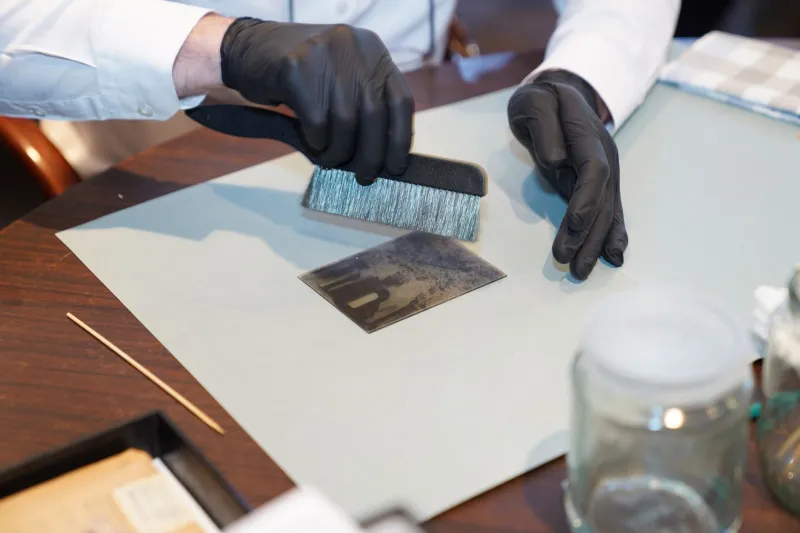
The fragment in question — a roughly hand-sized piece of heavily corroded metal, irregular in shape, with what appeared to be partial markings on one surface — had been sitting in a shallow archival tray in the storage facility of a prominent East Coast museum for decades. The label attached to the tray had faded to near-illegibility. Whatever ink had once identified the object's origin, donor, or accession number had degraded to a faint smear that nobody had been able to read for years.
The conservation team's assessment was straightforward: unidentifiable fragment, no provenance documentation, significant corrosion, no apparent exhibition value. The recommendation was disposal — standard procedure for uncataloged materials that couldn't be connected to any record in the collection database.
The tray was set aside pending final sign-off.
The Archivist Who Wasn't Supposed to Be There
She had retired from the museum's archival department several years earlier after a career spent working with historical documents and object records. She was back on the premises that particular afternoon for a reason that had nothing to do with the conservation lab — a meeting with a former colleague about a separate research project, something involving 18th-century correspondence that had nothing to do with metal fragments.
The route she took through the building happened to pass the conservation workspace. The door was open. She glanced in the way you do when you've spent decades in a building and can't quite walk past a room without checking what's happening in it.
The tray on the worktable caught her eye. Not because she recognized the object — she didn't, not at first — but because the shape of the corrosion pattern was unusual in a way she couldn't immediately articulate. She stopped. She asked if she could look more closely.
What she noticed, under a workbench magnifying lamp, was a series of marks along one edge of the fragment that the conservation team had assessed as surface damage from oxidation. They weren't. They were characters — partial, badly degraded, but characters nonetheless. Letters, and what appeared to be a date.
She recognized the style of the lettering from decades of working with 18th-century documents. The formation of certain letters, the spacing, the tool marks — they were consistent with a specific period and, more specifically, a specific type of object she had handled documentation for many years earlier.
What the Fragment Actually Was
The subsequent analysis took weeks. Metallurgical testing established the composition and approximate age of the metal. Imaging technology — including multispectral scanning that can reveal surface markings invisible to the naked eye — gradually reconstructed enough of the inscription to provide a legible partial text. Cross-referencing that text against historical records and the museum's own acquisition archives from the 19th century eventually produced a match.
The fragment was a piece of a casting mold — specifically, a portion of a mold used in the production of a small number of objects that had played a documented role in a significant episode of early American civic and political life in the late 1700s. The mold itself had been thought lost. The objects it had produced were known; several were in collections at other institutions, where their provenance had always included a gap at the production stage because the manufacturing equipment had never been located.
This fragment filled that gap. It was physical evidence of a manufacturing process that had previously been documented only through written records and the objects themselves — a behind-the-scenes piece of material history that connected the finished artifacts to their origin in a way that hadn't been possible before.
The museum's acquisition records, once investigators knew what to look for, turned up a 19th-century donation entry that matched — a brief, vague description from a donor whose collection had been accepted in bulk, cataloged in haste, and apparently never fully processed. The fragment had been sitting, correctly if unhelpfully labeled, in storage for well over a century.
The Question That Lingers
The artifact is now properly cataloged, conserved, and part of an active research initiative connecting it to the broader collection of objects it helps explain. Its near-disposal has become a minor institutional story — the kind of thing that gets mentioned in staff orientations as a reminder that provenance research matters and that unlabeled doesn't mean unimportant.
But the story raises a question that museum professionals will acknowledge, usually with a slightly uncomfortable pause: how many other trays are out there?
The honest answer is that nobody knows. Large collections — and American museums collectively hold millions of objects — contain substantial quantities of material that hasn't been fully processed, properly identified, or connected to its documentation. Some of it is genuinely insignificant. Some of it, in all probability, is not.
The retired archivist, for her part, has said that she almost didn't stop. She was running a few minutes late for her meeting. The door was open, the tray was on the table, and something made her look twice.
American history, it turns out, occasionally depends on someone running a few minutes late and happening to glance through an open door.