They Left for the War and Never Came Back — Now the Birds Own the Place
The Notice That Wasn't Official — But Nobody Waited to Find Out
Rumor travels fast in a small town. In the early 1940s, across the rural Great Plains, rumors about military land acquisition traveled faster than most. The federal government had been purchasing — and in some cases simply claiming — large tracts of land for training installations, airfields, ammunition depots, and proving grounds. Communities in the path of that expansion had limited options and limited time.
So when word reached a small farming community in western Kansas that the Army was eyeing the surrounding county for an expansion project, the response was immediate and largely voluntary. Families who had watched neighboring communities get displaced didn't wait for formal proceedings. They sold what they could sell quickly, packed what they could carry, and left.
The town didn't empty overnight. But within about eighteen months of those first rumors, the population had dropped from several hundred to nearly nothing. Farms went unworked. Storefronts closed. The school shut down for lack of students. A few elderly residents and one or two stubborn holdouts remained, but the community as a functioning entity had effectively dissolved.
Then the military project was cancelled.
A Project That Never Happened and a Town That Never Came Back
The specifics of why the expansion was cancelled vary depending on which records you consult — shifting strategic priorities, logistical reassessments, the simple bureaucratic chaos of wartime planning at scale. Whatever the reason, the land was never acquired. The Army never showed up. The project quietly disappeared from the planning documents.
But the people were already gone.
A handful of families attempted to return in the late 1940s and found the process harder than expected. Farms that had been sold cheaply in a panic were now in other hands. The infrastructure of community life — the school, the grain elevator, the social networks that make a small town function — had dissolved. Returning meant rebuilding almost from scratch, and most people who had already resettled elsewhere had no particular reason to do that.
The land stayed largely empty. And then something started happening in the emptiness.
What Eighty Years of Quiet Does to a Place
The transformation wasn't dramatic or sudden. It happened in the slow, patient way that ecological change usually happens — season by season, year by year, largely unobserved.
Without active farming, the cultivated fields began reverting. Native grasses reclaimed ground that had been plowed for decades. Wetland areas that had been partially drained for agriculture gradually re-established themselves. Scrub vegetation thickened along creek lines. The entire character of the landscape began shifting back toward something closer to what had existed before European settlement.
For migratory birds moving along the Central Flyway — one of the great North American migration corridors, running roughly north-south through the middle of the continent — this kind of habitat is increasingly rare and increasingly valuable. Wetlands, grasslands, and the transitional zones between them provide exactly what migratory species need: food, shelter, and rest during journeys that can span thousands of miles.
Bird populations found the area. Then more bird populations found it. Then ornithologists found the bird populations.
When Scientists Started Paying Attention
By the 1970s and 1980s, wildlife researchers cataloguing the Central Flyway were noting unusually high concentrations of migratory species in this corner of western Kansas. Shorebirds, waterfowl, grassland-dependent songbirds, and raptors were all showing up in numbers that seemed disproportionate to the size of the area. Survey data from multiple years confirmed it wasn't a fluke.
The reason, when researchers looked into it, was the land use history. Or rather, the land use non-history. Eighty-plus years of minimal human disturbance had allowed habitat complexity to develop in ways that actively managed land almost never achieves. The patchwork of wetland, grassland, and scrub that had grown up in the absence of agriculture was, almost accidentally, close to ideal.
Federal and state wildlife agencies took notice. Over a series of designations beginning in the 1990s and continuing into the 2000s, significant portions of the area were placed under formal protection — a combination of wildlife management designations and conservation easements that effectively locked the land into its current semi-wild state.
The Town That's Frozen in the Middle of All of It
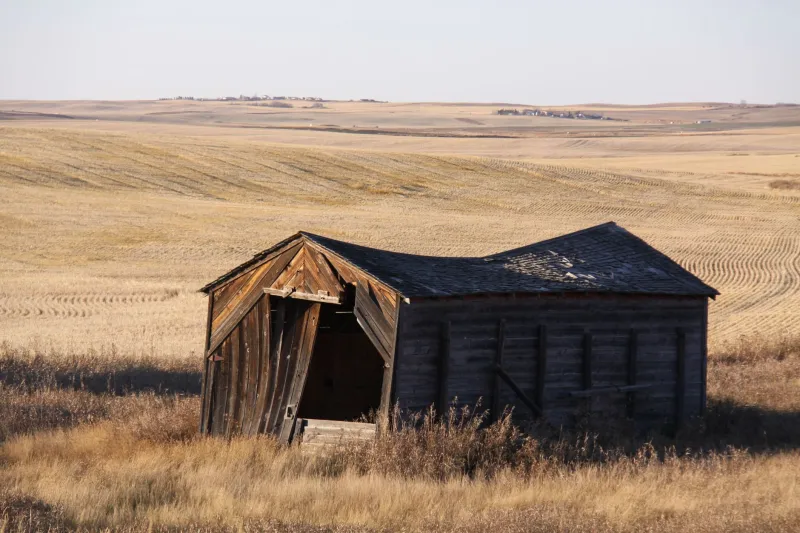
Here's where the story gets genuinely strange. Because the town didn't disappear entirely. A few structures survived — a farmhouse here, a deteriorating outbuilding there, the concrete foundation of what used to be a grain storage facility. The legal infrastructure of the community, including some property records and road designations, was never fully dissolved.
What exists now is something with no clean category: not a ghost town in the classic sense, because the land around it is actively managed and regularly visited by researchers and birders. Not an active community, because there's essentially no permanent population. Not a wilderness, because the remnants of human settlement are still physically present.
The protective designations that cover the surrounding habitat have, as a practical matter, made any large-scale redevelopment of the area extremely complicated. The birds, in a sense, have the stronger legal claim.
The Accidental Conservationists
There's an irony here that's hard to miss. The residents who fled that Kansas community didn't leave to create a wildlife sanctuary. They left because they were scared of losing their homes to a government project that never materialized. Their departure was an act of anxiety and loss, not environmental vision.
And yet the outcome of that departure — the decades of quiet, the habitat recovery, the bird populations that found a refuge in the emptiness — is now considered one of the more ecologically significant accidents in the region's conservation history.
The people who left didn't plan any of it. The birds didn't ask permission. And the place that resulted from all of that unplanned, unintended, slightly tragic chain of events is now protected by federal law.
Sometimes the strangest conservation stories are the ones where nobody was trying to conserve anything.