Nobody Planned This: The Pennsylvania Quarry Hole That Turned Into Its Own Private Wilderness
Just a Hole in the Ground
Abandoned industrial sites don't usually make it onto anyone's list of ecological wonders. Rust, contamination, invasive weeds, maybe some feral cats — that's the standard package. When a limestone quarry in central Pennsylvania shut down operations sometime in the mid-twentieth century, the surrounding community mostly just hoped it wouldn't become a dumping ground.
The quarry flooded. Decades passed. And then something genuinely strange started happening.
How a Quarry Becomes a Lake
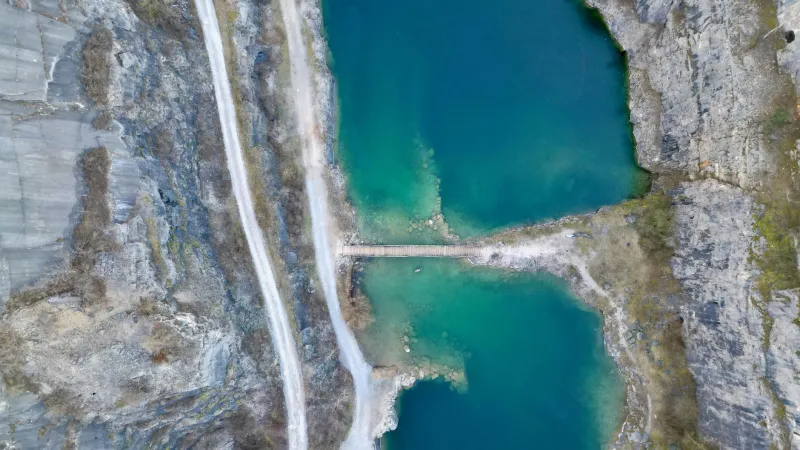
Limestone quarries flood because they have to. Once the pumps stop running, groundwater seeps in through the fractured rock and slowly fills the void. Depending on the size of the excavation and the local water table, this process can take anywhere from a few years to a few decades. In Pennsylvania's karst geology — a landscape riddled with underground water movement and soluble bedrock — the process tends to run fast.
By the time anyone was paying close attention to this particular site, it had transformed from a scarred industrial pit into something that looked, at a glance, almost natural. Clear water. Steep limestone walls. Depths that dropped sharply from the edges. The water chemistry was unusual — highly alkaline from the dissolved limestone, with a mineral profile unlike any natural lake in the region — but it was stable, and it was cold.
That combination of unusual chemistry and isolation set the stage for what came next.
The Predators Arrived First
Largemouth bass showed up early, likely introduced by local anglers who saw a convenient fishing hole. Bluegill followed. Then crayfish, almost certainly carried in on fishing equipment or wading boots. The alkaline water slowed some species down and seemed to accelerate others. Certain algae bloomed in densities rarely seen in natural Pennsylvania lakes. Aquatic plants that typically struggle in the region took hold along the shallower shelves.
What developed over the following decades wasn't a standard Pennsylvania pond ecosystem. It was something more like an experiment running without a scientist in charge.
Predator-prey dynamics shifted in ways that don't match textbook models. The bass population, cut off from normal migration patterns, developed feeding behaviors more typically associated with landlocked fish in the American West. Crayfish, normally a prey species, began occupying ecological roles usually reserved for bottom-feeding fish. Biologists who've studied the site describe it as a system that appears to have found its own equilibrium — just not one that matches any existing template.
The Part That Shouldn't Be Possible
And then there are the jellyfish.
Freshwater jellyfish — specifically Craspedacusta sowerbii, a species originally from the Yangtze River basin in China — have been documented in North American waters before. They show up occasionally in lakes and reservoirs, typically arriving as dormant microscopic bodies attached to aquatic plants. Most sightings are brief and sparse. The species technically can survive in freshwater, but it rarely thrives.
In this quarry, it thrives.
Biologists who've sampled the water during late summer — when the jellyfish are most visible — have documented population densities that are, by any reasonable measure, remarkable for an American inland water body. The creatures, translucent and roughly the size of a quarter, appear in numbers that suggest not just survival but active, sustained reproduction. The alkaline water chemistry, normally a strike against most freshwater species, appears to suit them fine. Maybe better than fine.
Why? Nobody has a confident answer. The leading hypothesis involves the water's unusually stable temperature gradient — the sheer-walled quarry geometry creates thermal layers that persist longer than in naturally shaped lakes — but that explanation doesn't fully account for the population density. There's something about this particular combination of factors that works for Craspedacusta sowerbii in a way that researchers haven't been able to replicate or fully explain.
What Nature Does With What We Leave Behind
The broader scientific conversation around sites like this one has shifted significantly in recent decades. Industrial abandonment used to be treated as purely a damage-control problem — contamination to remediate, habitat to restore, land to reclaim. And often that framing is entirely correct.
But some abandoned sites, particularly quarries and gravel pits that flood cleanly without toxic runoff, have become something else. They're unintentional laboratories. Places where ecological processes run without human management and produce outcomes that nobody designed and nobody predicted.
The Pennsylvania quarry hasn't been formally protected. It sits on private land and has been the subject of occasional discussion about development. Local naturalists have pushed back, arguing that whatever is happening there is worth understanding before it's paved over or drained.
So far, the quarry remains flooded, and the jellyfish remain.
The Strangest Part
Here's the detail that tends to stop people cold when they hear this story: the ecological complexity of this site — the unusual predator dynamics, the dense jellyfish population, the anomalous algae — developed entirely without human intention. Nobody seeded it. Nobody managed it. Nobody planned it.
A company dug a hole in the ground to extract stone, walked away when the economics stopped working, and nature filled the void with something that scientists are still trying to understand.
That's not restoration. That's not conservation. That's something harder to name — the world deciding what to do with the spaces we leave behind, and occasionally coming up with answers that are more interesting than anything we would have thought to try.