Galloping Gertie: The Engineering Marvel That Danced Itself Into Oblivion
When Physics Goes Rogue
On the morning of November 7, 1940, Leonard Coatsworth was driving his 1936 Studebaker across the Tacoma Narrows Bridge when the roadway began to move beneath him like a living thing. The bridge wasn't just swaying — it was dancing, twisting, and bucking like a bronco trying to throw off its rider.
What happened next became the most famous engineering disaster in American history, captured on 16mm film that still makes engineers' stomachs drop today. The Tacoma Narrows Bridge didn't just fail — it performed an impossible ballet of destruction that changed how every bridge in America would be built.
The Wonder of the Pacific Northwest
When it opened four months earlier, the Tacoma Narrows Bridge was hailed as a triumph of modern engineering. Spanning 2,800 feet across Puget Sound, it was the third-longest suspension bridge in the world and a marvel of sleek, Art Deco design.
The bridge cost $6.4 million (roughly $120 million today) and was supposed to stand for centuries. Its narrow, ribbon-like deck was seen as an elegant solution — lighter and more economical than the bulky designs of older bridges. Engineers were proud of how it seemed to float above the water with minimal visual impact.
But from the day it opened, the bridge had a disturbing habit: it moved. Even in light winds, the roadway would undulate in gentle waves. Workers nicknamed it "Galloping Gertie," and some visitors came specifically to experience the thrill of driving across a bridge that felt like a slow-motion roller coaster.
The Morning Everything Changed
November 7 started with winds of about 35-40 mph — strong but not unusual for the Pacific Northwest. However, something was different about how the wind interacted with the bridge that morning. Instead of the usual gentle undulation, the deck began to twist violently from side to side.
Leonard Coatsworth, a Tacoma News Tribune editor, was one of the last people to drive onto the bridge before authorities closed it. His car was thrown around so violently that he abandoned it mid-span and crawled on his hands and knees toward safety, the roadway rolling beneath him like the deck of a ship in a storm.
Left behind in the car was Tubby, Coatsworth's cocker spaniel, too terrified to follow his owner. The dog would become the bridge's only casualty — a detail that somehow makes the disaster even more heartbreaking.
The Dance of Destruction
What happened next defied everything engineers thought they knew about bridge behavior. The roadway began twisting in a corkscrew motion, with one side rising while the other dropped, creating angles of up to 45 degrees. The bridge was literally wringing itself apart.
Barney Elliott, a camera shop owner, happened to be filming the bridge that morning. His footage shows the impossible: a massive steel structure performing movements that seem to violate the laws of physics. The roadway ripples and waves like fabric in the wind, concrete and steel behaving more like water than solid matter.
For 40 minutes, the bridge twisted and bucked while engineers and spectators watched helplessly from both shores. Then, at 11:10 AM, the inevitable happened. The main span broke apart and crashed into Puget Sound, taking Leonard Coatsworth's Studebaker — and Tubby — with it.
The Science of Catastrophic Resonance
What destroyed the Tacoma Narrows Bridge wasn't weight, age, or poor construction. It was a phenomenon called aeroelastic flutter — essentially, the bridge became a massive musical instrument that the wind played until it broke.
The bridge's narrow, solid-sided design created the perfect conditions for disaster. As wind flowed over and under the roadway, it created vortices that began to match the bridge's natural frequency. Like a singer hitting the exact note that shatters a wine glass, the wind found the bridge's resonant frequency and amplified it until the structure couldn't handle the stress.
The irony is that the engineers who designed Galloping Gertie were trying to build a better bridge. Traditional suspension bridges were bulky and expensive, with heavy trusses and wide roadways. The Tacoma Narrows design was sleek, economical, and supposedly more efficient.
They were right about the efficiency — the bridge was extraordinarily sensitive to wind forces, so sensitive that moderate gusts could set off a chain reaction that would destroy it.
Rewriting the Rules
The collapse of the Tacoma Narrows Bridge sent shockwaves through the engineering community. Suddenly, every suspension bridge in America was suspect. The Golden Gate Bridge, completed just three years earlier with a similar narrow design, was immediately retrofitted with additional supports.
The disaster led to a complete revolution in bridge design. Engineers realized they had been focusing on static loads — the weight of traffic and the bridge itself — while ignoring dynamic forces like wind-induced vibration. New bridges would need to account for aerodynamics as much as structural strength.
The University of Washington built a wind tunnel specifically to test bridge models, and every major suspension bridge built since 1940 has been subjected to extensive aerodynamic testing. The lessons learned from Galloping Gertie's dance of death are built into every bridge span in America.
The Resurrection
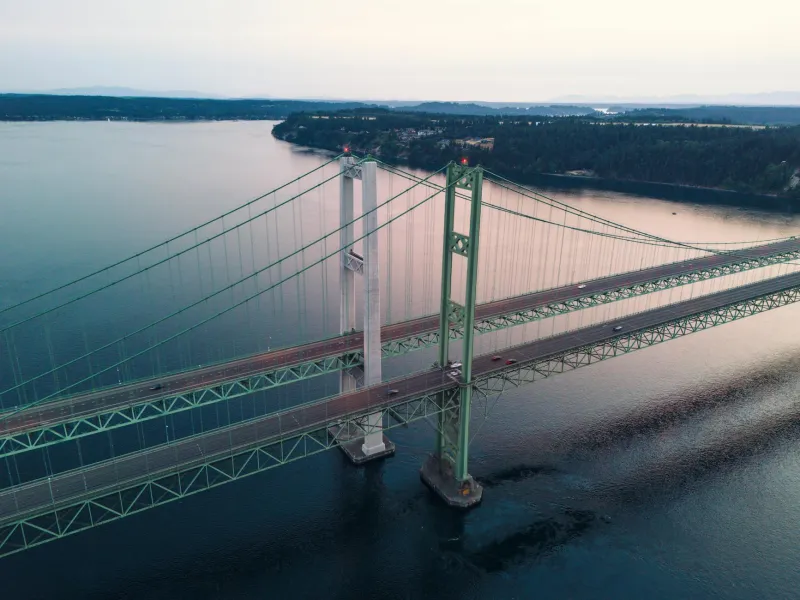
A new Tacoma Narrows Bridge opened in 1950, built with the hard-won knowledge of its predecessor's failure. The new design included deep trusses that allowed wind to pass through rather than creating the vortices that had doomed the original.
The replacement bridge has stood for more than 70 years without incident, a testament to the engineering lessons learned from the most spectacular failure in bridge history.
The Footage That Changed Everything
Barney Elliott's film of the bridge collapse became one of the most important engineering documents ever created. The footage is still shown in engineering schools around the world as a reminder of what happens when theoretical knowledge meets unexpected reality.
Watching the film today is still mesmerizing and disturbing. The bridge moves with an organic fluidity that seems impossible for a steel structure. It's beautiful and terrifying — a reminder that even our most solid-seeming creations can be undone by forces we don't fully understand.
When Engineering Meets Humility
The Tacoma Narrows Bridge collapse was more than just an engineering failure — it was a lesson in humility. The engineers who designed Galloping Gertie weren't incompetent or careless. They were skilled professionals working with the best knowledge available at the time.
But they learned that nature has a way of finding weaknesses we never anticipated, and that the most elegant solutions sometimes contain the seeds of their own destruction.
The bridge that danced itself to death in 40 minutes changed how engineers think about their profession. It proved that understanding the rules of physics isn't enough — you also have to respect the possibility that those rules can combine in ways you never imagined, turning a triumph of human engineering into a cautionary tale about the power of unintended resonance.