When Solitude Breeds Innovation
Imagine spending eight years alone on a chunk of granite, watching ships pass like distant memories while fog swallows your world for weeks at a time. That was life for Thomas Whitmore at Gull's Rest Light Station, perched on Maine's most isolated outcrop from 1887 to 1895. What he created in that solitude would quietly revolutionize maritime communication — though his name would vanish from history.
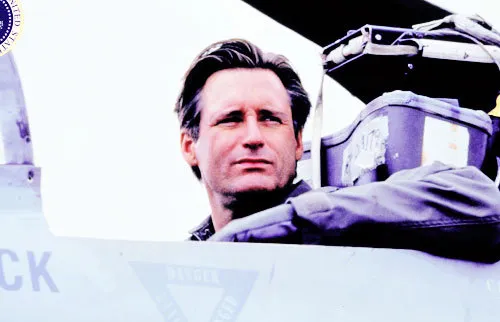 Photo: Thomas Whitmore, via 64.media.tumblr.com
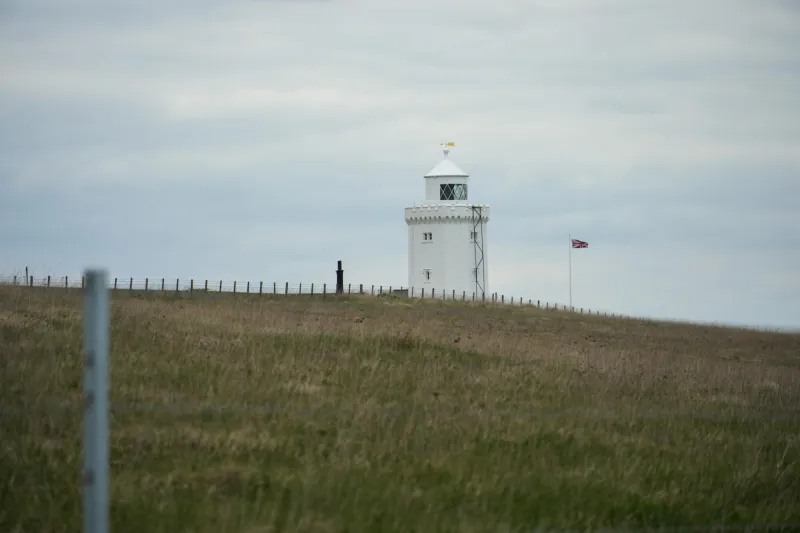
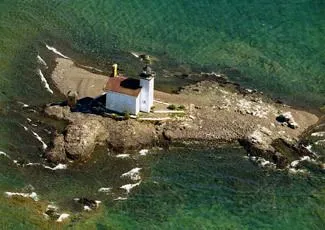 Photo: Gull's Rest Light Station, via alchetron.com
Whitmore wasn't supposed to be an innovator. He was supposed to keep the light burning and log ship movements. But when you're the only human for twenty miles in any direction, necessity has a way of making inventors out of ordinary people.
The Problem Nobody Else Saw
Supply ships visited Gull's Rest every six weeks, weather permitting. Standard maritime flag signals worked fine for basic messages — "Need supplies," "All well," "Medical emergency." But Whitmore needed to communicate more complex information: specific equipment failures, detailed weather observations, requests for particular tools or medicines.
The traditional flag system was clunky. Spelling out "Replace broken lens assembly, third order" required dozens of individual signals. Ships would drift while trying to decode lengthy messages, sometimes missing critical details in rough seas.
Whitmore started developing shortcuts. Not official ones — just personal abbreviations to make his life easier.
The Code That Wrote Itself
By 1890, Whitmore had created something remarkable: a compressed signaling system that could convey complex technical information in just a few flag combinations. Where standard signals might require fifteen separate flags to request specific lighthouse parts, Whitmore's system did it with three.
His breakthrough was treating lighthouse maintenance like a language with its own grammar. Instead of spelling everything out letter by letter, he created symbols for common concepts: lens types, weather patterns, supply categories, equipment conditions. The system was intuitive enough that ship crews could learn the basics in a single visit.
Captains started asking their signal officers to "talk to the lighthouse keeper the quick way." Supply ship crews began carrying cards with Whitmore's symbols sketched out. Within two years, fishing boats along the entire Maine coast were using modified versions of his shortcuts.
The Quiet Revolution
By 1894, elements of Whitmore's system had spread far beyond Gull's Rest. Ship logs from Boston to Halifax mention "Maine signals" or "lighthouse shorthand" without crediting any inventor. Maritime supply companies started printing reference cards with symbols that looked suspiciously similar to Whitmore's innovations.
The U.S. Lighthouse Board never officially acknowledged Whitmore's contributions, but their 1896 "Updated Signal Procedures" manual quietly incorporated several of his efficiency improvements. Maritime academies began teaching "streamlined coastal communication" that was essentially Whitmore's code with the serial numbers filed off.
The Man Who Disappeared
Whitmore retired in 1895 and moved to a small inland farm in Vermont. He never wrote about his signaling innovations, never sought recognition, never even mentioned them in letters to family. To him, they were just practical solutions to daily problems.
When maritime historians in the 1920s tried to trace the origins of "modern coastal signaling," they found official records but no individual inventor. The innovations seemed to have emerged from collective maritime wisdom rather than one man's isolation-driven creativity.
Hidden in Plain Sight
The irony is perfect: a communication system designed to help one lonely man talk to the outside world became so successful that it erased its creator from history. Whitmore's code worked so well that it felt natural, inevitable — the kind of improvement that seems obvious only after someone else thinks of it.
Today's maritime communication systems still use principles Whitmore developed on his granite island: compressed symbols, contextual shortcuts, technical abbreviations that prioritize clarity over completeness. Every time a ship signals "Engine trouble, need parts" instead of spelling out each word, they're using concepts refined by a man who spent eight years watching the horizon.
The Language of Loneliness
Whitmore's story reveals something profound about human innovation: sometimes the most revolutionary ideas come from people who aren't trying to change the world. They're just trying to make their own small corner of it work a little better.
In his case, the corner happened to be a lighthouse that every ship along the coast eventually passed. His personal solution to the problem of isolation became everyone's solution to the problem of efficient communication.
The next time you see ships in a harbor using flag signals, remember that some of those gestures trace back to one man's determination to make himself understood across twenty miles of empty ocean. He succeeded so completely that history forgot to write down his name.