Lake Superior's Grudge: The Cargo Ship That Couldn't Escape the Same Deadly Waters
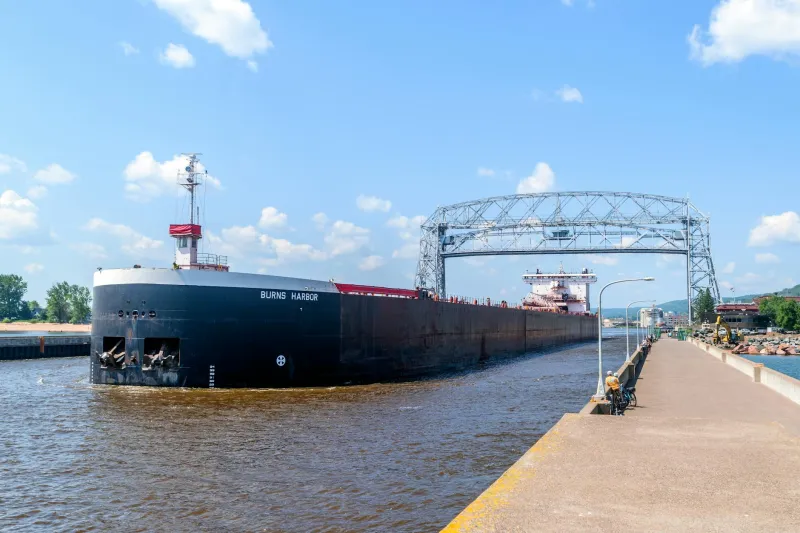
The Ship That Lake Superior Wouldn't Let Go
Lake Superior has claimed over 6,000 ships in recorded history, but none with quite the persistence it showed toward the SS Kamloops. This 250-foot cargo vessel had the misfortune of sinking twice in the same stretch of water, forty years apart, as if the lake had marked it for a specific kind of doom.
The story begins in 1927 and ends in 1967, bookended by two disasters so eerily similar that even hardened Great Lakes sailors started talking about curses.
First Dance with Death: December 1927
The SS Kamloops was built in 1924 as a package freighter, designed to carry everything from grain to Christmas presents across the Great Lakes. She was considered a modern vessel for her time, equipped with steam heat, electric lights, and a wireless radio — luxuries that many lake ships still lacked.
On December 5, 1927, Captain William Brian loaded the Kamloops with a mixed cargo in Fort William, Ontario (now Thunder Bay). The manifest included everything from Christmas packages bound for prairie towns to barrels of whiskey and cases of tinned goods. With winter closing in fast, this would likely be one of the last runs of the shipping season.
The weather forecast called for moderate winds and snow flurries — typical December conditions on Superior. What the forecast didn't predict was the sudden temperature drop that would turn those flurries into a blinding blizzard with winds exceeding 70 mph.
The First Sinking
Somewhere between Isle Royale and the Keweenaw Peninsula, the Kamloops encountered what Great Lakes sailors call a "white hurricane" — a winter storm so fierce that snow and spray combine to create zero visibility. The ship's last radio transmission, received at 11:30 PM on December 6, was brief: "Taking heavy seas. Will try to make Keweenaw."
She never made it.
The Kamloops vanished somewhere in the 30-mile stretch between Twelve O'Clock Point and Eagle Harbor, one of Lake Superior's most dangerous passages. Search efforts were hampered by continued storms and the early onset of ice. By Christmas, the search was called off, and the Kamloops was presumed lost with all 22 hands.
The Resurrection
What happened next defied both logic and Great Lakes tradition. In June 1928, as ice cleared from Superior's northern shores, commercial divers located the Kamloops sitting upright in 180 feet of water, her hull intact and cargo holds relatively dry.
The discovery was remarkable for several reasons. First, ships that sink in Superior's deep, cold waters typically break apart on the way down. Second, the location — just three miles from Eagle Harbor — suggested the crew had almost made it to safety before disaster struck.
Most surprisingly, the ship appeared salvageable. Her engines were undamaged, her hull showed no major breaches, and even some of the cargo was recoverable. The Kamloops had apparently gone down fast but intact, possibly after taking on water through damaged hatches during the storm.
Back from the Dead
The salvage operation took most of the summer of 1928. Using compressed air to force water from the holds and patching the relatively minor hull damage, crews managed to refloat the Kamloops in September. She was towed to a shipyard in Duluth for complete restoration.
The rebuild was extensive. New engines, updated navigation equipment, reinforced hull plating, and improved watertight compartments. When she returned to service in 1929, the Kamloops was arguably safer than she'd been when first launched.
For nearly four decades, the reborn Kamloops sailed the Great Lakes without incident. She survived the brutal storms of the 1930s, served as a wartime transport during World War II, and continued hauling cargo well into the 1960s. Crew members joked that she was "unsinkable" — a boast that would prove tragically ironic.
The Return to Doom
By 1967, the Kamloops was showing her age. The shipping industry was transitioning to larger, more modern vessels, and the old package freighters were being phased out. Her owners planned to retire her after the 1967 season, making one final run before sending her to the scrapyard.
On November 10, 1967 — exactly 40 years and 11 months after her first sinking — the Kamloops departed Duluth with a cargo of iron ore pellets bound for Cleveland. The weather was deteriorating, with gale warnings posted across the western Great Lakes, but Captain James Morrison was an experienced Superior sailor who had navigated worse conditions.
As the ship passed the Keweenaw Peninsula, she encountered the same type of late-season storm that had claimed her four decades earlier. Winds gusting to 80 mph drove waves over 25 feet high, and snow reduced visibility to near zero.
History's Cruel Echo
At 2:15 AM on November 11, the Kamloops radioed a distress call from a position just eight miles from where she had sunk in 1927. "Taking on water forward," Captain Morrison reported. "Attempting to reach Eagle Harbor."
Those were the last words anyone heard from the Kamloops.
When the storm cleared two days later, search planes found debris floating in almost exactly the same area where the ship had been discovered 40 years earlier. Oil slicks, life preservers, and pieces of the superstructure were scattered across a three-mile radius, but the ship herself had vanished into Superior's depths.
This time, there would be no resurrection. The Kamloops had gone down in over 400 feet of water, far too deep for salvage operations with 1960s technology.
The Numbers Game
The statistical probability of the same ship sinking twice in the same location is virtually incalculable. Lake Superior covers 31,700 square miles, but both Kamloops disasters occurred within a few miles of each other. Both happened during late-season storms with similar wind speeds and wave heights. Both occurred while the ship was attempting to reach the same harbor of refuge.
Maritime historians have proposed various explanations. The area between Isle Royale and the Keweenaw Peninsula is known for sudden weather changes and confused seas where different wave patterns collide. The underwater topography creates unusual current patterns that can overwhelm even experienced ships.
But the coincidences go beyond geography. Both sinkings occurred during the final runs of the shipping season. Both captains were experienced Superior sailors. Both ships were carrying full loads and making good time before the weather deteriorated.
The Lake's Memory
Great Lakes sailors are a superstitious bunch, and the Kamloops story has become part of Superior folklore. Some claim the lake "remembered" the ship and was determined to claim her permanently. Others suggest that certain vessels are simply marked for destruction in specific waters.
The more practical explanation may be that the Kamloops was a victim of her own history. The area where she sank twice is genuinely dangerous, particularly for ships of her size and design. The fact that she survived there for 40 years after her first sinking may simply have been borrowed time.
The Final Resting Place
The Kamloops remains on the bottom of Lake Superior, her exact location known but unmarked. Unlike her first sinking, which became a celebrated salvage story, her second disappearance was quickly overshadowed by the loss of the Edmund Fitzgerald just eight years later.
But among Great Lakes historians, the Kamloops holds a unique place. She's the only major vessel known to have sunk twice in the same waters, making her both a maritime curiosity and a sobering reminder that Lake Superior never forgets — and rarely forgives.
The ship that couldn't escape Superior's grip remains down there still, a steel monument to the idea that some bodies of water keep their own score, and sometimes demand payment twice for the same debt.