The Town That Voted to Move Itself Two Miles Downhill — And Actually Did It
Imagine if your entire neighborhood decided to pack up and move — not just the people, but the actual buildings, sidewalks, and telephone poles. Now imagine doing this in the dead of winter, using nothing but horses, logs, and sheer determination. That's exactly what happened in Hibbing, Minnesota, in one of the most bizarre acts of collective ambition in American history.
The Discovery That Changed Everything
In 1892, Hibbing was a typical northern Minnesota logging town, carved out of the wilderness by hardy settlers who came for timber. But when mining surveys revealed that the town was sitting on top of one of the richest iron ore deposits in North America — part of what would become the legendary Mesabi Range — everything changed overnight.
The iron ore beneath Hibbing wasn't just valuable; it was practically pure. Mining companies offered the town a deal that sounds like something from a fever dream: move your entire community, and we'll make you all rich. The alternative was watching mining operations slowly consume the town piece by piece.
Faced with this ultimatum, the residents of Hibbing made a decision that defied all logic and engineering wisdom of the time. They voted to relocate the entire town — lock, stock, and barrel — to a new site two miles away.
The Great Migration Begins
What followed was perhaps the most ambitious moving project in American history. Starting in 1919, the great relocation of Hibbing began. But this wasn't a gradual process of families packing up and starting fresh elsewhere. This was a literal, physical transplantation of an entire community.
Buildings that had stood for decades were jacked up off their foundations and loaded onto massive wooden sleds. The town's most impressive structures — including a four-story brick hotel, the high school, churches, and dozens of homes — were carefully lifted and prepared for their journey across the frozen Minnesota landscape.
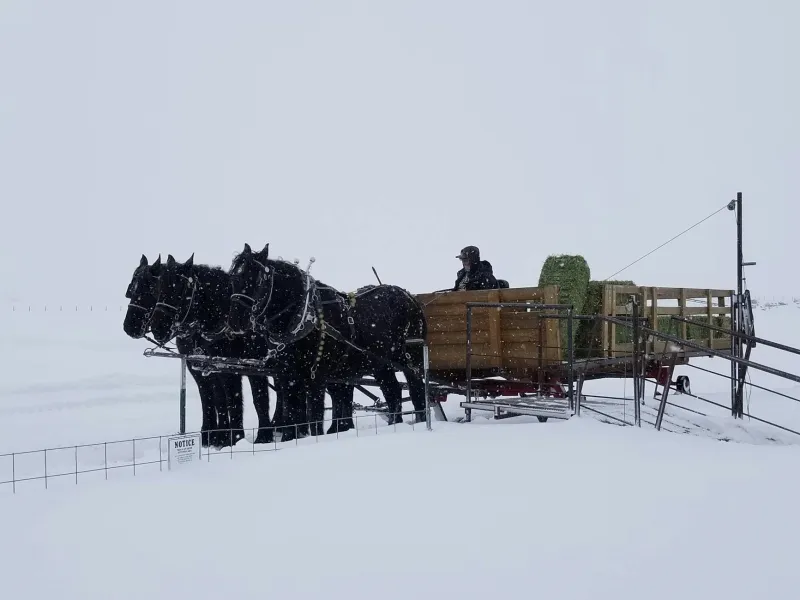
The logistics were staggering. Teams of up to 24 horses were hitched to the largest buildings. Smaller structures could be moved with just eight horses, but even modest homes required careful planning and precise execution. The winter freeze was crucial — the sleds needed frozen ground to move smoothly, and the cold weather helped preserve the structural integrity of buildings during transport.
Engineering Miracles on Ice
The most incredible part wasn't just that they moved entire buildings — it's that they did it successfully, repeatedly, for over a decade. The town's opera house, complete with its ornate interior and heavy stage equipment, made the journey intact. The Hibbing High School, a massive brick structure that would be challenging to move even with modern equipment, was relocated without losing a single window.
Local newspapers documented the surreal sight of entire city blocks slowly crawling across the snowy landscape. Families would often stay in their homes during the move, cooking meals and going about their daily routines while their houses slid along on runners behind teams of horses.
One of the most famous relocations involved the Sellers Hotel, a four-story building that took several weeks to move. Guests continued to stay in the hotel during the relocation, and the dining room remained open for business. Imagine checking into a hotel room and waking up in a completely different location.
The Price of Progress
The financial incentives were enormous. The Oliver Iron Mining Company paid for the entire relocation project, plus gave residents cash payments and guaranteed jobs in the new mines. For many families, the move represented a chance at prosperity they never could have imagined.
By the time the last building was relocated in 1921, over 200 structures had made the journey to "New Hibbing." The old town site was transformed into the Hull-Rust-Mahoning Open Pit Mine, which became one of the largest open-pit iron mines in the world.
A Legacy Written in Iron
Today, visitors to Hibbing can see both the results of this incredible undertaking and the massive crater that justified it. The Hull-Rust-Mahoning mine is now a tourist attraction, offering visitors a chance to peer into the enormous hole that was once a thriving town.
New Hibbing prospered from the iron ore wealth, eventually becoming the birthplace of Bob Dylan and home to one of the most impressive high schools in America — built with mining money and featuring amenities that rivaled many colleges.
The Town That Refused to Die
The story of Hibbing's great migration remains unique in American history. While other towns have been relocated due to dam construction or environmental disasters, no other community has ever voluntarily voted to physically move itself for economic opportunity.
It's a testament to the audacious spirit of early 20th-century America — the belief that with enough determination, horses, and frozen ground, even the impossible could become routine. The residents of Hibbing didn't just adapt to change; they literally picked up their lives and carried them to a better future, one building at a time.