When Geography Forgot: The Desert Hamlet That Ruled Itself for Two Months
The Line That Wasn't There
Somewhere between the Joshua trees and abandoned mining claims of the Mojave Desert, a handful of families discovered in 1967 that they were living in a place that technically didn't exist. Not on any map that mattered, anyway.
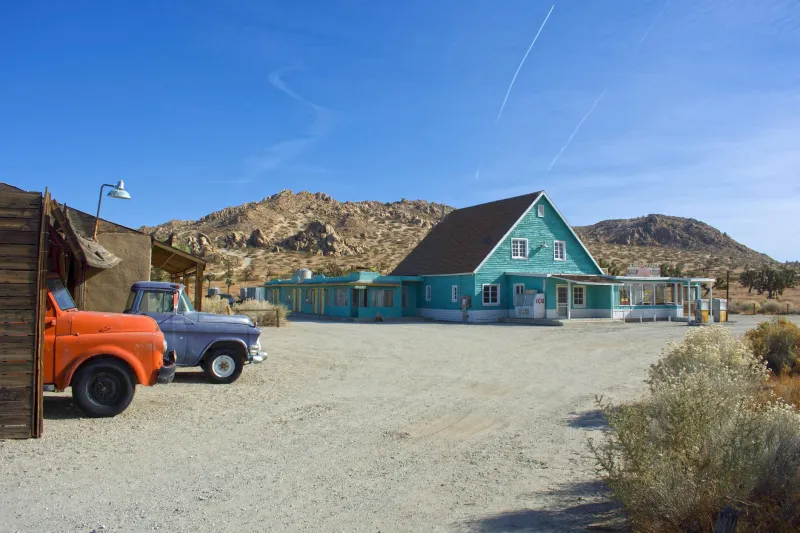
The settlement of Cima Flats — population 47 — had always been one of those forgotten corners of America where the mail came twice a week and the nearest traffic light was three hours away. But when residents tried to incorporate as a proper town that spring, they stumbled onto a bureaucratic nightmare that would have made Kafka proud.
The land surveys were wrong. All of them.
A Cartographer's Nightmare
The problem started in 1863, when California and Nevada were still figuring out where one state ended and the other began. The original boundary survey had missed Cima Flats entirely — a 12-square-mile patch of desert that existed in the gap between two different mapping projects.
For over a century, nobody cared. The land was mostly useful for rattlesnakes and the occasional prospector. But by the 1960s, a small community had grown up around a general store and gas station that served travelers heading to Las Vegas. When they applied for municipal status, both California and Nevada politely declined.
Neither state wanted to claim them.
"We weren't on California's books, and Nevada said we weren't their problem either," recalled Martha Hendricks, who ran the general store and became the settlement's unofficial historian. "The county clerk in Barstow just shrugged and said we were 'geographically ambiguous.'"
The Republic of Cima Flats
What happened next sounds like something out of a Mark Twain story. On July 4th, 1967 — because of course it was the Fourth of July — the residents gathered at Hendricks' store and declared independence.
It started as a joke. Someone suggested they should just become their own country if nobody wanted them. But as the beer flowed and the desert heat made everything seem possible, the joke took on a life of its own.
They drafted a constitution on the back of a road map. It was surprisingly thorough for something written in ballpoint pen by people who'd been drinking since noon. The document established a "Democratic Republic of Cima Flats" with a directly elected president (they called him mayor to sound less pretentious), a council of five citizens, and a tax rate of exactly zero dollars.
Bill Morrison, a retired mining engineer who owned the gas station, was elected mayor by a vote of 31-16. His campaign platform was simple: "Free coffee for everyone and no speed limits on Sundays."
Running a Country on Desert Time
For the next two months, the Republic of Cima Flats operated as an independent nation. Sort of.
They issued their own "passports" — actually just index cards with a rubber stamp Morrison had ordered from a catalog. The republic's currency was poker chips from a Las Vegas casino, though most transactions still happened in regular dollars because nobody wanted to explain the exchange rate to truckers buying gas.
The government met every Tuesday at the general store, where they passed laws like "No honking after 10 PM" and "All dogs must be good dogs." Their most serious legislation involved designating the Joshua tree behind the post office as the national tree and establishing a $5 fine for littering.
"We took it seriously, but not too seriously," Hendricks remembered. "Bill wore a cowboy hat to council meetings and called it his presidential crown."
The World's Quietest Revolution
What made the whole situation even stranger was how long it took anyone to notice. The Republic of Cima Flats conducted its affairs in complete obscurity, invisible to the outside world.
They weren't paying state taxes, but nobody expected them to. The mail still came through the U.S. Postal Service because the mailman, Eddie Vargas, was also a citizen of the republic and saw no conflict of interest. When a highway patrol officer stopped by in August, Morrison just told him they were having a "community celebration" and offered him free coffee.
The officer wrote in his report that the locals were "friendly but eccentric."
Reality Catches Up
The Republic of Cima Flats came to an end not with military intervention or diplomatic crisis, but with a phone call from a very confused county assessor.
Someone in Sacramento had finally noticed the gap in the tax rolls. A team of surveyors arrived in early September 1967, spent three days with their instruments and charts, and determined that Cima Flats was actually 200 yards inside California.
Just like that, 47 people stopped being citizens of their own country and became Californians.
"The surveyor was real apologetic about it," Morrison said years later. "Like he was personally responsible for ending our independence. We told him not to worry about it. Being mayor was more work than I expected anyway."
The Footnote That Almost Wasn't
The story of the Republic of Cima Flats might have stayed buried in local archives forever if not for a graduate student researching boundary disputes in the 1990s. Even then, it took years for anyone to believe it had actually happened.
The handwritten constitution survived, tucked inside Martha Hendricks' recipe box. The rubber stamp Morrison used for passports turned up at a garage sale in Barstow. But most of the "official" documents of the republic had been used to start campfires or line bird cages.
"Nobody thought it was important enough to preserve," Hendricks explained. "We were just having fun with a ridiculous situation."
Today, Cima Flats is a ghost town. The general store closed in the 1980s, and most of the residents moved away as the desert reclaimed their brief experiment in self-governance. But for 61 days in the summer of 1967, they proved that sometimes the most American thing you can do is decide you're not American at all — at least until the paperwork gets sorted out.