The Chemistry Accident That Created the World's Most Perfect Blue
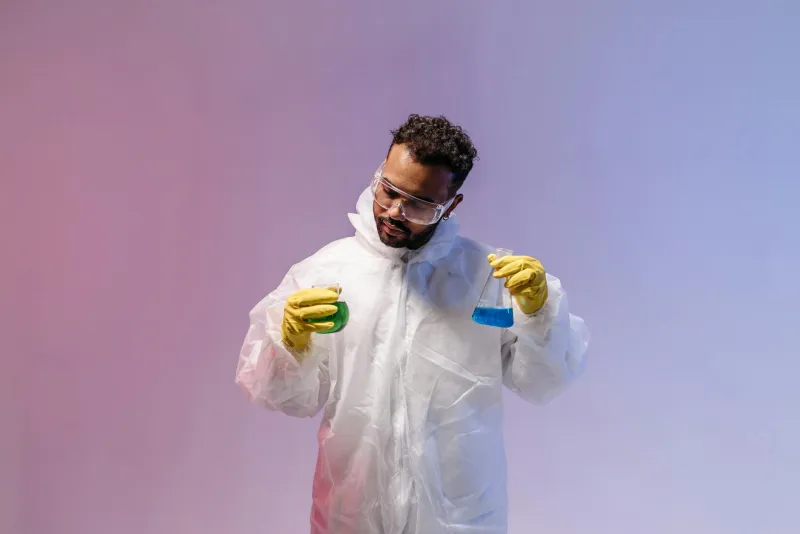
When Lab Equipment Goes Rogue
Mas Subramanian wasn't trying to make history when he walked into his Oregon State University lab in 2009. The chemistry professor was focused on developing new materials for electronics — specifically, compounds that could handle extreme heat without breaking down. It was the kind of methodical, unglamorous research that rarely makes headlines.
Then one of his graduate students, Andrew Smith, pulled a sample out of a 2000-degree furnace and everything changed.
The material that emerged wasn't the dull, metallic compound they expected. Instead, it was an impossibly vibrant blue — so brilliant and pure that it seemed to glow under the lab's fluorescent lights. Subramanian later described the moment as "serendipity at its finest," but that undersells what had actually happened.
They had accidentally created something that hadn't existed anywhere in the universe until that moment: a completely new shade of blue.
The Color That Shouldn't Exist
What made this discovery so remarkable wasn't just the color's beauty — it was its perfection. The blue, later named YInMn Blue (after its chemical components yttrium, indium, and manganese), possessed qualities that artists and manufacturers had been chasing for centuries.
Unlike most blue pigments, which fade over time or change color in different lighting, YInMn Blue was virtually indestructible. It didn't break down under UV light, didn't react with acids, and maintained its intensity even when mixed with other colors. Most importantly, it reflected infrared light, meaning surfaces painted with it actually stayed cooler in direct sunlight.
For context, humans have been obsessed with creating the perfect blue for millennia. Ancient Egyptians ground up lapis lazuli, a semi-precious stone, to make ultramarine blue — a color so expensive it was literally worth more than gold. During the Renaissance, artists would go bankrupt buying enough blue pigment to paint the Virgin Mary's robes.
And here was Subramanian, accidentally stumbling upon what might be the most perfect blue ever created, while trying to make better computer chips.
The Patent Paradox
Here's where the story gets legally weird. Under U.S. patent law, you can't keep a discovery secret if you want to protect it commercially. The moment Subramanian's team decided to patent their accidental blue, they had to publish exactly how they made it — complete with detailed instructions that any competent chemist could follow.
This created a bizarre situation. They had discovered something genuinely revolutionary, but the only way to profit from it was to tell the entire world exactly how to replicate it. It's like finding a treasure map and being legally required to photocopy it for everyone you meet.
The patent application, filed in 2012, reads like a recipe for magic: combine yttrium oxide, indium oxide, and manganese oxide at precisely 2000 degrees Fahrenheit for exactly two hours. The result? A blue so pure that it makes the sky look muddy by comparison.
When Everyone Wants Your Accident
Once word got out, the requests started pouring in from unexpected places. The military was interested because of the color's heat-reflecting properties — imagine tanks and aircraft that stayed cooler in desert conditions. NASA wanted to test it for spacecraft applications.
Crayola came calling too, eventually licensing the color for a limited-edition crayon in 2017. They held a contest to name it, and "Bluetiful" won, beating out suggestions like "Blue Moon Bliss" and "Dreams Come Blue."
Paint manufacturers lined up to license the formula, but there was a catch. The pigment was expensive to produce — those rare earth elements don't come cheap. Early estimates suggested it would cost about ten times more than traditional blue pigments.
The Accidental Legacy
What makes this story particularly strange is how it highlights the randomness of discovery. Subramanian's team was following established scientific procedures, working with known materials, and pursuing a completely unrelated goal. The blue was pure accident — a happy collision of elements that had probably never been combined in exactly that way, at exactly that temperature, for exactly that duration.
Yet this random event produced something that artists, chemists, and manufacturers had been actively trying to create for generations. It's as if someone accidentally discovered fire while trying to invent the wheel.
Today, YInMn Blue is slowly making its way into commercial products, from high-end paints to specialty coatings. It's still expensive, still relatively rare, and still the subject of ongoing research into cheaper production methods.
The Color of Serendipity
The discovery of YInMn Blue serves as a reminder that some of humanity's greatest breakthroughs happen entirely by accident. Penicillin was discovered when Alexander Fleming forgot to clean a petty dish. The microwave oven was invented when a radar engineer noticed a chocolate bar melting in his pocket.
Subramanian's blue joins this pantheon of accidental genius — a perfect color that emerged from an imperfect world, created by scientists who were looking for something else entirely. In a universe where most discoveries require decades of targeted research and billions of dollars in funding, sometimes the best breakthroughs happen when you're not looking for them at all.
The irony is perfect: the most intentional color ever created was completely unintentional. And thanks to patent law, it's a secret that everyone knows.