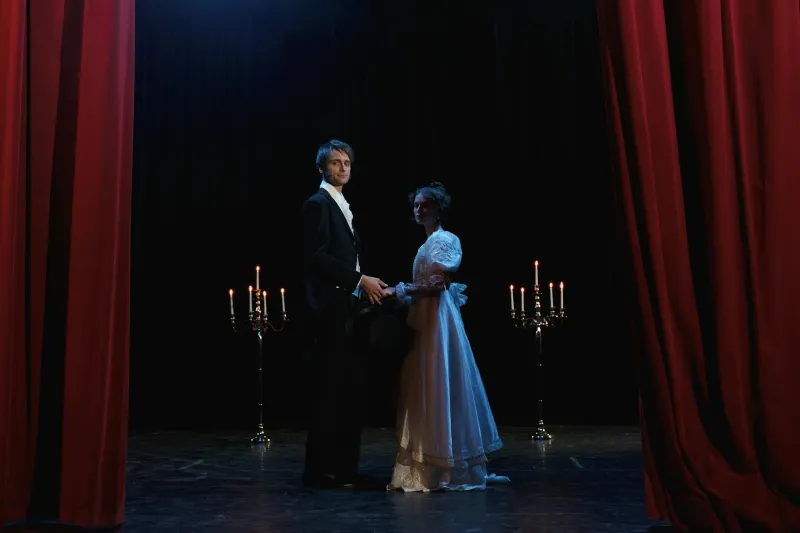
The Night Everything Changed
October 15, 1924. The Lyceum Theatre buzzes with opening night energy for "Midnight's Promise," a romantic drama that Broadway insiders predict will run for years. The lead actor, Harrison Wells, is already being whispered about for next year's theater awards. The production has everything: star power, financial backing, and advance ticket sales that stretch into spring.
At 7:47 PM, thirteen minutes before curtain, Wells collapses in his dressing room.
Panic spreads through the backstage area like wildfire. The theater is packed with critics, investors, and society figures who've paid premium prices for opening night. Refunding tickets would be financial disaster. Postponing would kill momentum. The show, as they say, must go on.
Enter Thomas Whitmore, a 26-year-old understudy who'd been with the production for six weeks of rehearsals but had never performed the role in front of an audience.
The Performance of a Lifetime
What happened next defies theatrical logic. Whitmore didn't just fill in for Wells — he elevated the entire production. Critics who attended that night described his performance in terms usually reserved for legendary actors at the peak of their careers.
The New York Tribune's theater critic wrote: "Mr. Whitmore inhabited the role with such natural authority that one forgot this was an emergency replacement. His portrayal revealed depths in the character that escaped notice during previews."
The Times was even more effusive: "In thirty years of covering Broadway, I have rarely witnessed such a complete transformation of material through sheer force of talent. Mr. Whitmore didn't just save the evening — he made it unforgettable."
By the final curtain, the audience was on its feet. Whitmore took seven curtain calls. Theater veterans in attendance later said they'd never seen an understudy receive such an ovation.
The Vanishing Act
Here's where the story takes its impossible turn: Thomas Whitmore never appeared on a professional stage again.
Not the next night, when Wells was still recovering and the role was his for the taking. Not when the production's investors offered him a starring contract for the next season. Not when two other Broadway producers approached him with leading roles in their upcoming shows.
Within a week of his triumph, Whitmore had quit the production, declined all offers, and — according to theater records — never auditioned for another professional role.
"It was the most baffling thing I ever witnessed," recalled stage manager Dorothy Chen in a 1967 interview. "Here was a young man who'd just proven he belonged on Broadway's biggest stages, and he walked away like it meant nothing to him."
The Search for Answers
Theater historians have spent decades trying to understand Whitmore's disappearance. The few surviving records paint a picture of a competent but unremarkable actor who'd worked in regional theater before landing the understudy role. Nothing in his background suggested the extraordinary talent he displayed that October night.
His fellow cast members remembered him as quiet, professional, and seemingly committed to his craft. "Tom always knew his lines, always hit his marks," actress Helen Morrison recalled years later. "But none of us suspected he had that kind of performance in him."
The mystery deepened when researchers discovered that Whitmore had given no interviews after his performance. No quotes to newspapers, no statements to the theater press, no explanations for his sudden departure from the production.
Theories and Dead Ends
Over the years, theater scholars have proposed various explanations for Whitmore's vanishing act. Some suggested stage fright — that the intensity of his opening night success terrified him. Others theorized about family obligations or financial pressures that forced him to abandon his career.
The most romantic theory holds that Whitmore's performance was so perfect, so complete, that he realized he'd never top it and chose to preserve that single moment of theatrical perfection rather than risk diminishing it with lesser performances.
In the 1950s, a theater researcher claimed to have tracked down Whitmore working as a bookkeeper in Albany, living under a different name. But when contacted, the man denied ever being on Broadway and had no knowledge of theater beyond what any casual observer might possess.
The Production Lives On
Ironically, "Midnight's Promise" became one of the decade's biggest hits, running for 847 performances over two years. Harrison Wells recovered and returned to the role, delivering solid performances that earned him considerable acclaim. But theater veterans who saw both actors consistently maintained that Whitmore's single performance remained the production's artistic peak.
The show's success made Whitmore's absence even more puzzling. Here was a production that could have made him wealthy and famous, running night after night without him.
Programs from the show's run listed Wells as the lead, with a footnote acknowledging Whitmore's "memorable opening night performance." It's one of the few official records that prove he existed at all.
The Ghost in Theater History
What makes Whitmore's story particularly haunting is how thoroughly he erased himself from theatrical history. No photographs survive of his performance. No recordings exist of his voice. Even his contract with the production has vanished from the theater's archives.
By the 1940s, many people in the theater world had begun to doubt the story entirely. Some suggested it was an elaborate publicity stunt, or a case of collective misremembering by critics caught up in opening night excitement.
But the reviews remain, archived in newspaper morgues across the city. The box office records show that ticket sales spiked after opening night, driven by word-of-mouth about an extraordinary performance. Something remarkable happened at the Lyceum Theatre that October evening.
The Legend Persists
Today, Thomas Whitmore exists in Broadway lore as theater's greatest mystery — the understudy who delivered a perfect performance and then disappeared. Drama schools tell his story as either inspiration or cautionary tale, depending on the instructor's perspective.
Some actors claim to understand his choice. "Maybe he realized that one perfect night was worth more than a lifetime of good-enough performances," suggests contemporary actor Michael Torres. "Maybe he knew something the rest of us don't."
Others see it as the ultimate waste of talent. "He robbed audiences of what could have been a legendary career," argues theater historian Dr. Patricia Williams. "We'll never know what he might have achieved."
The Unanswered Question
Nine decades later, Thomas Whitmore's motivation remains one of Broadway's most intriguing unsolved mysteries. Did he fear he couldn't repeat his success? Was he overwhelmed by sudden attention? Did personal circumstances force him away from theater?
Or did he simply achieve exactly what he set out to achieve — one perfect moment on stage — and decide that was enough?
The truth died with Whitmore, whose fate after leaving Broadway remains as mysterious as his decision to leave. But his single performance continues to fascinate theater lovers, proving that sometimes the most powerful stories are the ones that end before we're ready to let them go.
In a business built on repetition — eight shows a week, night after night, year after year — Thomas Whitmore chose singularity. One night, one performance, one perfect moment that nobody who witnessed it ever forgot.
Perhaps that was the point all along.